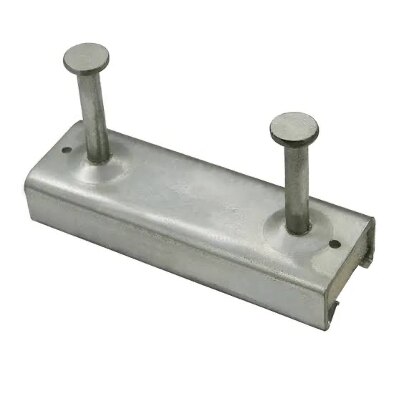
A cast-in channel (anchor channel) is a C-shaped steel profile with anchors welded or forged to its back, cast into concrete so that T-head bolts can slide along its continuous slot — giving an adjustable, high-load connection point without drilling into cured concrete or cutting reinforcement, unlike post-installed anchors. Profiles are cold-formed or hot-rolled in Q235B / Q355B carbon steel or SS304 / SS316 stainless, hot-dip galvanized for outdoor, tunnel and subterranean service. When selecting a supplier, require ISO 9001:2015 certified manufacturing, TÜV test reports covering tensile pull-out and longitudinal shear, and EN 10204 mill certificates per batch.
In modern facade installation, tunnelling and precast construction, cast-in channels (anchor channels) have transformed how heavy loads are secured to concrete. Unlike post-installed drilled anchors — which can damage reinforcement and create micro-cracks — cast-in channels are set before the pour, giving an adjustable, high-load connection point. This guide covers the mechanics, the standard product matrix, and the ISO 9001 + TÜV framework a serious supplier should stand behind.
1. The engineering and mechanics of cast-in channels
An industrial anchor-channel line produces cold-formed or hot-rolled cast-in channels designed for maximum load transfer and flexible geometric positioning. Three characteristics define a premium channel:
- Integrated anchor design. A C-shaped steel channel profile carries factory-welded or forged-on anchors (I-anchors or round-head studs) on its back. The assembly transfers tension and shear forces deep into the concrete core.
- Dynamic adjustability. Once cast in, the continuous slot lets specialised T-head bolts (channel bolts) and matching nuts slide freely along the channel — seamless multi-directional adjustment that compensates for on-site alignment errors.
- Superior corrosion resistance. For harsh outdoor, infrastructure and subterranean environments, channels are hot-dip galvanized (HDG) or made from high-grade stainless steel, giving decadal resistance to oxidation.
2. High-value application scenarios
Cast-in channels provide reliable mechanical interlocking across a wide range of high-stress structural and infrastructure environments:
- Curtain wall & facade systems. Anchoring unitized glass, aluminium or natural-stone facades to the edges of concrete floor slabs — absorbing dynamic wind loads while allowing rapid alignment.
- Tunnelling & railway infrastructure. Fixing overhead catenary systems (OCS), drainage pipes, utility cables and ventilation equipment inside concrete tunnel linings (metro and high-speed rail) without risking structural cracking.
- Utility tunnels & MEP installation. Supporting heavy pipe racks, HVAC and MEP frameworks in underground corridors, with lifetime adjustability as infrastructure needs evolve.
- Precast concrete elements. Integrated directly into precast beams, columns and walls during factory casting, streamlining on-site steel assembly and minimising field-welding.

3. Cast-in channel vs post-installed drilled anchor
The core reason engineers specify cast-in channels on new-build work is that they never touch the cured concrete — no drilling, no severed rebar, no micro-cracking. The trade-off is that they must be positioned before the pour.
| Criterion | Cast-in channel | Post-installed drilled anchor |
|---|---|---|
| Reinforcement damage | ✓ None — set before pour | ✕ Drill can sever rebar |
| Concrete micro-cracking | ✓ None | ✕ Expansion / drilling induces cracks |
| On-site adjustability | ✓ Stepless along the slot | ✕ Fixed at drilled position |
| Fatigue / dynamic loads | ✓ High (tunnels, facades) | Moderate |
| Retrofit on existing concrete | ✕ Must be pre-planned | ✓ Flexible |
| Best fit | New-build facade, tunnel, precast | Retrofit / repair fixings |
4. Standardized product matrix & technical configurations
To speed up engineering submittals and project cross-referencing, the standard production portfolio maintains the following core technical baselines:
| Feature / parameter | Specifications & properties | Engineering utility |
|---|---|---|
| Profile geometry | Standard C-channel (cold-formed / hot-rolled) | High bending and torque resistance |
| Matching fasteners | Heavy-duty T-head bolts (grade 4.8 / 8.8 / stainless) | Secure interlocking, slip-resistant fit |
| Material grades | Q235B / Q355B carbon steel or stainless (SS304 / SS316) | Optimises load-bearing to weight ratio |
| Surface finish | Hot-dip galvanized (HDG) or electro-galvanized | Exceptional longevity in high-humidity zones |
| Anchor attachment | Automated precision welding / mechanical forging | High pull-out and dynamic-shear resistance |
| Customization | Custom lengths, slot widths and anchor spacing | Perfect fit for custom precast moulds |
5. International compliance: ISO 9001 & TÜV test reports
Industrial concrete anchorage leaves zero room for structural compromise. To eliminate supply-chain liabilities for international partners, a credible factory backs its lines with independent verification:
- ISO 9001:2015 certified manufacturing. The complete cycle — raw steel sourcing, computerised profile shaping, automated anchor welding and galvanizing — is audited and certified under the ISO 9001 Quality Management System, so the structural tolerances of the first metre of channel match the millionth metre.
- Authoritative TÜV test reports. The channel-and-bolt assemblies are validated by TÜV (Technischer Überwachungsverein) across critical thresholds — ultimate tensile pull-out strength, longitudinal shear resistance and steel metallurgical composition. Official TÜV reports are available for engineering submittals and structural design approval.
6. Our multi-stage closed-loop quality control
Aligned with ISO 9001, every batch of cast-in channels clears a five-stage checkpoint before export clearance:
- Incoming quality control (IQC). Every batch of steel coil and anchor bar is checked for thickness, profile width and tensile baseline consistency.
- First article inspection (FAI). At the start of a run, sample profiles and matching T-bolts are checked against CAD blueprints for precise slot dimensions and locking interfaces.
- In-process quality control (IPQC). Continuous audits monitor anchor welding / forging on the channel back to eliminate micro-cracking or weak fusion.
- 4-hour scheduled spot audits. Supervisors pull live samples every four hours to verify slot widths and edge tolerances so T-bolts slide without jamming or excessive play.
- Pre-shipment final audit (OQC). Coating-thickness checks (HDG microns) and load-bearing tests confirm alignment with the TÜV-certified parameters before loading.
Watch the factory process video
7. Frequently asked questions
What is a cast-in channel (anchor channel)?
A cast-in channel — also called an anchor channel — is a C-shaped steel profile with anchors (I-anchors or round-head studs) welded or forged to its back, cast directly into a concrete element. A continuous slot lets T-head bolts slide along its length, providing an adjustable, high-load connection point for facades, tunnel fixtures and MEP services without drilling into cured concrete.
Cast-in channel vs post-installed drilled anchor — which is better?
Cast-in channels are set before the pour, so they never cut reinforcement or create micro-cracks, and they offer stepless adjustability along the slot. Post-installed anchors are more flexible for retrofits but risk hitting rebar, induce local cracking, and have lower fatigue performance. For new-build facades, tunnels and precast, cast-in channels are the higher-reliability, lower-liability choice.
What T-bolt grades fit a cast-in channel?
Standard matching fasteners are heavy-duty T-head bolts in grade 4.8, 8.8 or stainless (A2/A4). The bolt head geometry must match the channel's slot lip so it interlocks and resists slip. Always pair the bolt grade to the design load and the channel's finish — stainless channels take stainless bolts to avoid galvanic corrosion.
What corrosion protection is available for cast-in channels?
For outdoor, infrastructure and subterranean use, channels are hot-dip galvanized (HDG) or electro-galvanized; for the most aggressive environments they are made from stainless steel SS304 or SS316. HDG gives decadal oxidation resistance for facades and tunnels; SS316 is specified for coastal, chemical or permanently wet environments.
What steel grades are cast-in channels made from?
Carbon-steel channels are typically Q235B or Q355B; stainless variants use SS304 or SS316. Q355B offers a higher yield for heavier facade and tunnel loads, while stainless is chosen where corrosion, not strength, governs. The grade is stated on the mill certificate supplied with each batch.
Where are cast-in channels used?
Primary applications are curtain-wall and facade anchoring to slab edges, overhead catenary and services in metro and rail tunnel linings, pipe racks and MEP frameworks in utility tunnels, and cast-in connections in precast beams, columns and walls. In each case the slot provides lifetime adjustability as loads or layouts change.
What certification should a cast-in channel supplier provide?
Ask for ISO 9001:2015 certified manufacturing covering the full cycle from steel sourcing to galvanizing, plus authoritative TÜV test reports validating tensile pull-out, longitudinal shear and steel composition. Official TÜV documentation and mill certificates should be available for engineering submittals and structural design approval.
Can cast-in channels be customized?
Yes. Length, slot width and anchor spacing can be customized to suit specific precast moulds and facade grids. Cold-formed and hot-rolled profiles are both available, with anchor attachment by automated precision welding or mechanical forging depending on the required pull-out and dynamic-shear capacity.
Summary
When optimising a commercial facade or tunnelling project, component reliability translates directly into operational safety. By combining a precise C-channel geometric profile with an ISO 9001-certified, TÜV-tested quality framework, a supplier delivers cast-in channel systems that structural engineers and global contractors can specify with confidence.
Who wrote this, and why you can check it
We make these parts, we don't resell them
Qingdao Chontan Industry has been supplying the precast and prestress industries for over 20 years, from our own factory in Chengyang District, Qingdao. Everything in these guides comes from producing, testing and shipping the components they describe — not from a catalogue.
Our own test floor, not an outsourced claim
Anchors are verified in-house before they leave:
- 30 T – 300 T universal tensile testers for pull-out and tensile testing
- Low-temperature impact testing — the test that catches brittle behaviour
- Metallographic structure analysis and hardness testing
- Material sampled for microscopy before the first manufacturing operation
- Dimensional inspection against drawings, with purpose-made gauges during production
Facts are attributed to the standard, not to us
Where these guides quote a limit — a load, a wear limit, an inspection interval, a cover formula — it is attributed to the standard that sets it (EN 1992, EN 10204, EN 13101, DIN 405, VDI/BV-BS 6205, ACI 318, the Machinery Directive). We tell you which document to read, so you never have to take our word for it.
What we will not do
- We do not publish another manufacturer's load tables as our own data.
- We do not quote a rating without its conditions — concrete grade, embedment, edge distance.
- Illustrative numbers are labelled illustrative; design from your supplier's tested data.
- Where we are uncertain, we say so and point you to the primary source.
Need ISO 9001 / TÜV-tested cast-in channels for your project?
20+ years of export experience. Cold-formed and hot-rolled channels in Q235B / Q355B or SS304 / SS316, HDG or stainless, with custom lengths, slot widths and anchor spacing. TÜV test reports and mill certificates included. We'll quote against your drawing in 24 hours.