1. 埋込みアンカーチャンネルとは
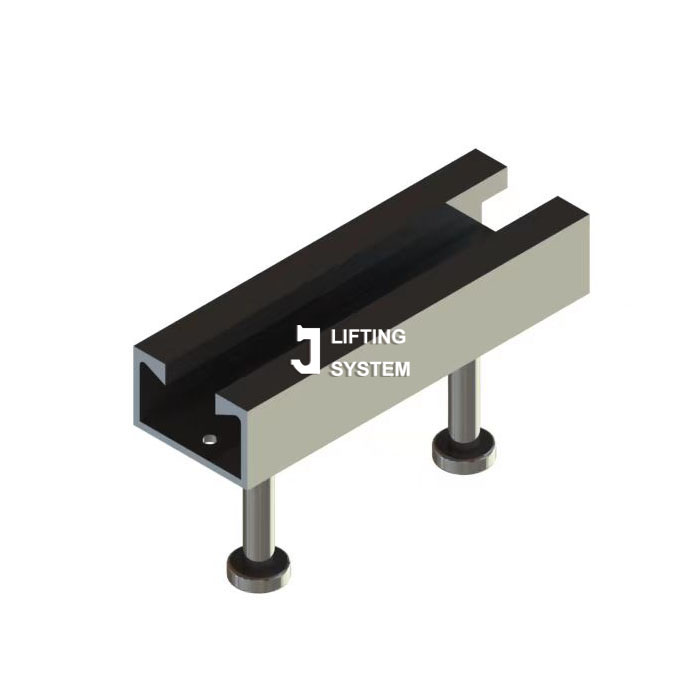
埋込みアンカーチャンネルとは、コンクリート表面と面一になるように打設時に埋め込まれる、溶接アンカー付きの C 形鋼断面材です。硬化後、T ボルトをチャンネルのどちらかの端からスライド挿入し(または事前に切り出した鍵穴形状から差し込み)、90° 回転させてチャンネルリップ下で固定。あらゆる構造接続を受けることができます — ファサードブラケット、カーテンウォール方立、MEP レール、二次鉄骨、看板、落下防止アンカー等。
本製品カテゴリの形状は 1950 年代以来、事実上のグローバル標準として確立されており、Chontan の CIC-HR および CIC-CR シリーズもこの標準形状を採用しています。
本製品カテゴリが存在する理由 — そしてあらゆるファサード施工業者が指定する理由 — は機械的だけでなく運用面にあります:
- Adjustability along the channel. A 600 mm channel accepts a T-bolt anywhere along its length, infinitely positioned without drilling. A drilled mechanical anchor commits to one location forever.
- No concrete drilling on site. All anchoring is in the precast plant or during the concrete pour. Site labour just slides a T-bolt and torques a nut.
- Reuse and repositioning. If a curtain wall mullion needs to move 50 mm during commissioning (and it always does), you slide the T-bolt — you don't drill new anchors.
- Tested system performance. Both the channel and the matched T-bolt have been pull-tested as one assembly. A drilled anchor depends on installer skill; a channel depends on factory geometry.
2. 熱間圧延 vs 冷間圧延 — 最も重要な単一の決定
埋込みチャンネルには 2 つの製造ルートがあり、根本的に異なる 2 つの製品を生み出します:
| Hot-rolled (HR) | Cold-rolled (CR) | |
|---|---|---|
| Process | Solid steel bar heated to 1,150 °C and rolled to C-profile in one pass | Sheet steel bent to C-profile at room temperature |
| Wall thickness | 5–9 mm | 2–4 mm |
| Channel lip geometry | Toothed / serrated — interlocks with T-bolt teeth | Smooth — relies on T-bolt friction |
| Static load capacity | Up to 72 kN per T-bolt | Up to 18 kN per T-bolt |
| Dynamic / seismic load | ✓ Permitted | ✗ Not permitted |
| Typical use | Curtain wall mullion anchorage, façade dead load, MEP rails carrying equipment | Rainscreen sub-frame, signage, light cladding, secondary handrail |
| Chontan series | Chontan CIC-HR | Chontan CIC-CR |
| Indicative cost ratio | 1.0 × (baseline) | 0.4 × (60% cheaper per metre) |
3. 構造と T ボルトのメカニズム
The five load-transfer interfaces
- Bracket → Nut: friction + bearing under washer.
- Nut → T-bolt: thread engagement (typically M12, M16 or M20).
- T-bolt teeth → Channel lip teeth: form-fit interlock (hot-rolled only) or friction (cold-rolled).
- Channel body → Welded anchors: tested-and-certified weld.
- Anchors → Concrete cone: bearing of anchor head on surrounding concrete.
5 つのいずれもが荷重で破壊し得る。チャンネル SWL は 5 つの容量の最小値を安全係数で除した値。§5 参照。
4. 規格と性能評価
埋込みチャンネルを仕様決定する際は、荷重容量・防食・品質証明をカバーする以下の規格と第三者試験データを仕様書に引用してください:
| Standard / Document | What it governs | Why it matters |
|---|---|---|
| ACI 318-19 Appendix D | Concrete-side capacity (cone, side blow-out, splitting) | The US / international standard for concrete capacity calculation. Used in tandem with the steel-side resistance from the manufacturer's test data. |
| ISO 1461 | Hot-dip galvanizing thickness ≥ 45 μm | Sets the corrosion protection floor. Outdoor channels without HDG fail within 5–10 years. |
| ASTM A123 | HDG for North American market | Equivalent to ISO 1461 with slightly different testing protocol — accept either. |
| EN 10204 3.1 | Mill certificate format | The only cert grade an independent QA can audit against heat / batch number. |
5. 荷重容量と 5 つの破壊モード
チャンネル SWL は 5 つの破壊経路の最小値で決まる:
- F1. T-bolt rupture — bolt tensile failure (M12 class 8.8 ≈ 50 kN ultimate).
- F2. Channel lip pull-out — channel lip bends open under bolt head tension. Unique to anchor channels; doesn't exist in solid anchors.
- F3. Anchor weld rupture — fillet weld at anchor-to-channel joint fails.
- F4. Concrete cone — concrete pulls out around the anchor head.
- F5. Concrete edge breakout — concrete spalls between anchor and panel edge.
Worked example: Chontan CIC-HR 40/22 in C25/30 concrete with M16 class 8.8 T-bolt
チャンネル:熱間圧延、40 × 22 mm C 形材、肉厚 6 mm、丸アンカー 2 本溶接(Ø 12 mm、h_ef = 95 mm)、間隔 250 mm、縁距離 a_R = 100 mm。
- F1 T-bolt: M16 class 8.8 stress area 157 mm², UTS 800 N/mm² × 157 = 126 kN. γ = 3.0 → allowable 42 kN.
- F2 Lip pull-out: Per test data, hot-rolled 40/22 channel rated 36 kN per T-bolt. γ already applied. → 36 kN.
- F3 Weld: 6 mm fillet weld around Ø 12 anchor, weld length ≈ 38 mm, shear stress allowable 220 N/mm² → 50 kN. → 50 kN.
- F4 Concrete cone: N_Rk,c = 7.5 × √25 × 95^1.5 = 34.7 kN. γ_c = 2.5 → 13.9 kN.
- F5 Edge breakout (a_R = 100 mm < h_ef = 95 × 1.5 = 142 mm): apply reduction factor 0.7 → 13.9 × 0.7 = 9.7 kN. ← governs
Per-bolt SWL = min(42, 36, 50, 13.9, 9.7) = 9.7 kN ≈ 0.99 t. To raise SWL to design-load 15 kN, move the channel inward to a_R ≥ 142 mm (eliminates F5 reduction) — new SWL = 13.9 kN ≈ 1.4 t. Or increase embedment by switching to CIC-HR 50/30 with h_ef = 120 mm → concrete cone 49 kN, full F4 = 19.6 kN, full F5 = 19.6 × 1.0 = 19.6 kN, SWL = min(42, 36, 50, 19.6, 19.6) = 19.6 kN ≈ 2.0 t.
6. Chontan 埋込みチャンネルの仕様
| Parameter (40/22 class) | Chontan CIC-HR 40/22 |
|---|---|
| Channel geometry standard | Toothed, industry-standard pattern |
| Cross-system T-bolt compatibility | ✓ with industry-standard T-bolts |
| Channel wall thickness | 6.0 mm |
| Anchor type | Round bar Ø 12 mm, h_ef 95 mm |
| Rated SWL per T-bolt | 36 kN |
| Channel lengths available | 150 – 6,000 mm + custom |
| Standard finish | HDG ≥ 55 μm, A4 stainless |
| Third-party test data | ✓ on request |
| EN 10204 3.1 cert | ✓ default |
| Indicative FOB price (1k metre lot) | USD 5.20 – 7.80 / m |
| Lead time | 25 – 40 days |
| OEM private label | ✓ from 2,000 m |
年間 50,000 m のチャンネルを使うカーテンウォール案件では、中国直送によるコスト削減は運賃前で年 600,000~900,000 USD に達する。Chontan の第三者試験報告と各出荷の EN 10204 3.1 証明書により、構造エンジニアによる受入審査を問題なく通過できる。
7. 5 つの質問で適切なチャンネルを仕様決定
- Load type? Static + secondary → cold-rolled OK. Dynamic / seismic / structural → hot-rolled mandatory.
- Peak design load per T-bolt? Look up the smallest channel that delivers SWL ≥ design load with your edge distance and concrete strength.
- Edge distance available? < h_ef → upsize channel or move inward. ≥ 1.5 × h_ef → full SWL.
- Channel length? Field-adjustability requirement drives this. 300–500 mm for curtain wall typical; 600–1000 mm for MEP rails.
- Exposure class? Interior dry → zinc plate. Exterior + freeze-thaw → HDG ≥ 55 μm. Coastal < 1 km from sea → A4 (316) stainless.
8. 縁端距離・中心間隔・埋込み深さ
アンカーチャンネルは単一の埋設アンカーより多い 3 つの縁距離を確認する必要がある:
- a_e (longitudinal): distance from the channel end to the panel edge (parallel to channel axis). Typically ≥ 50 mm.
- a_R (transverse): distance from the channel mouth to the nearest perpendicular panel edge. Drives concrete-side capacity (F5).
- a_a (between anchors): centre-to-centre spacing between welded anchors along the channel. Manufacturer-fixed at typically 150 mm or 250 mm.
| Condition | SWL factor | Mitigation |
|---|---|---|
| a_R ≥ 1.5 × h_ef (typical 140 mm) | 1.00 | — |
| a_R = 1.0 × h_ef | 0.85 | Verify per test data |
| a_R = 0.5 × h_ef | 0.55 | Add U-bar tail reinforcement |
| a_R < 0.5 × h_ef | not permitted | Special engineering |
| a_e < 50 mm | 0.70 | End cap mandatory + move inward |
| Concrete f_c at lift = 20 MPa (vs 30 MPa rated) | 0.82 | Delay loading 7 days |
9. 10 ステップの施工手順
- Verify channel model against drawing — size, length, finish, anchor type. Reject any channel missing the laser-etched system mark.
- Verify foam plug condition inside the channel — must be intact and seated, no concrete-ingress path.
- Position channel on formwork at drawing coordinates. For nail-on plate: nail the perforated plate to the formwork face at minimum 4 points.
- Verify anchor orientation — anchors point away from the formwork (into the concrete body).
- Place reinforcement around the channel anchors — at least 2 stirrups crossing the anchor zone.
- Pour concrete per normal practice. Vibrate AWAY from the channel — direct vibration can dislodge the foam plug.
- Cure to f_c per channel test data (typically 25 N/mm² minimum for full SWL).
- Strip formwork. Remove nail-on plate — pry away from the channel mouth, not toward it.
- Remove foam plug by hand or compressed air. Inspect channel interior — clean, no concrete residue, lip teeth (if hot-rolled) intact and undamaged.
- Install T-bolt — insert from channel end, slide to position, rotate 90° to lock. Verify engagement mark visible on bolt head. Torque the nut to the manufacturer-specified value (typically 40–80 Nm depending on bolt size).
10. 防食 — チャンネルと T ボルトを揃える
チャンネルと T ボルトは電食を避けるため腐食クラスを一致させる必要がある:
| Exposure | Channel finish | T-bolt finish | Expected service life |
|---|---|---|---|
| Interior dry (warehouse, office) | Zinc plate 8 μm | Zinc plate 8 μm | 50+ years |
| Interior wet (basement, pool) | HDG 55 μm | HDG 55 μm | 50 years |
| Exterior temperate (façade) | HDG 55 μm | HDG 55 μm | 40–60 years |
| Coastal (< 1 km from sea) | Stainless A4 (316) | Stainless A4 (316) | 60+ years |
| Industrial / chemical exposure | Stainless A4 (316L) duplex 2205 | Duplex 2205 | 40+ years |
Never mix HDG channel with stainless T-bolt in exterior environments — the galvanic potential difference creates accelerated zinc corrosion at the lip-bolt interface. If the budget only allows stainless on one component, put it on the channel (more steel mass, harder to replace).
11. 調達とコスト最適化
年間 50,000 m のチャンネルを使うファサード施工業者の総支出はブランド次第で 250,000~1,300,000 USD。これを大きく動かす 3 つのレバー:
- Standardise channel sizes. Most contractors drift into 4–6 channel sizes. A spec review usually finds 2–3 cover 90% of brackets. Each size consolidated saves 5–8% on unit price.
- Match T-bolts to channel manufacturer. Cross-brand sourcing voids the matched-system test data. Buy channel + T-bolt + nut from one supplier.
- Bulk-buy on annual contract. 80,000 m blanket order vs 10,000 m spot purchase typically drops FOB China price by 18–25%. Chontan price ladder: 5k m / 20k m / 80k m / 200k m.
12. よくある質問
埋込みアンカーチャンネルとは何ですか?
溶接アンカー付き C 形鋼断面で、チャンネル開口を躯体表面と面一にして埋設される。硬化後 T ボルトをチャンネルに差し込み 90° 回転させてロックする。構造接続(ファサードブラケット、カーテンウォール、MEP レール、二次鉄骨)を受ける。チャンネルと T ボルトの組合せにより、硬化したコンクリートに穴あけせずにチャンネル長手方向で無段階調整可能な接続位置を提供する。
熱間圧延と冷間圧延のアンカーチャンネルの違いは?
熱間圧延チャンネル(Chontan CIC-HR)は高温下で鋼棒から鍛造され、せん断下で T ボルトを機械的にかみ合わせる歯付きまたは噛合うリップを持ち、静的・動的・地震時荷重に対応。冷間圧延チャンネル(Chontan CIC-CR)は鋼板から成形 — 30~40% 安価だが、二次接続(レインスクリーン、サイン、軽量外装材)の静的荷重に限定される。
アンカーチャンネルの荷重容量はどう決定するのですか?
耐力は 5 つの破壊モードの最小値:(1) T ボルト引張破断、(2) チャンネルリップ引抜(リップ曲げ破壊)、(3) アンカー鋼材破断、(4) コンクリートコーン引抜、(5) コンクリート縁部破壊。支配モードはチャンネル形状、アンカー間隔、縁距離、コンクリート強度、荷重方向で決まる。メーカーの設計ソフト(Chontan ChannelDesign)または ACI 318 付録 D に基づく手計算を使用する。
埋込みアンカーチャンネルを規定する規格は?
ACI 318-19 付録 D(コンクリート側耐力)、ISO 1461(HDG 防食 ≥ 45 μm)、ASTM A123(北米 HDG)、EN 10204 3.1(ミル証明書)。チャンネルシステムは、荷重容量と防食をカバーする第三者試験データとともに仕様化する。
埋込みチャンネルの最小縁端距離はいくらですか?
最小縁距離は通常チャンネル端で 0.5 × h_ef(アンカー埋込深さ)、隣接アンカー間で 1.5 × h_ef。フル SWL には縁距離 ≥ h_ef が必要。縁に近いほどメーカーの低減係数が適用される(縁距離 0.5 × h_ef で SWL は通常 0.55 に低下)。コンクリート端に平行なチャンネルは特に敏感 — 可能な限りチャンネルは端に垂直に走らせる。
Chontan のチャンネルは他社製の T ボルトと互換性がありますか?
歯付チャンネル(主流タイプ):歯ピッチがメーカーごとに異なるため、T ボルトはメーカー間で直接互換ではない。チャンネルと T ボルトは整合システムとして仕様化する。平滑チャンネル(Chontan CIC-CR)では、スロット幅に合う汎用 Rd またはメートル T ボルトはブランド横断で互換。
T ボルトの「係合マーク」とは?
T ボルト頭部に刻まれた線または矢印で、チャンネル内で 90° 回転してロック位置に来た時にのみ視認できる。施工者にとっての二者択一 go/no-go 確認 — マークが見えなければボルトはロックされていない。マークのない T ボルトは不採用とする。
アンカーチャンネルは型枠にどう設置しますか?
3 つの方法:(1) 釘打ちプレート — チャンネル開口に取付けた穿孔鋼板を型枠面に釘留めする方式。最安でプレキャスト工場で最も一般的。(2) 磁石 — チャンネル背面の磁石で鋼製型枠に保持する方式。再利用可能だが高価。(3) フォーム充填 — チャンネル内空隙のフォームストリップでコンクリート流入を防止し、硬化後は開口が清浄に保たれる。チャンネル端部は常にエンドキャップで密封し、側面からのコンクリート流入を防ぐ。
標準的なアンカーチャンネルの長さは?
標準チャンネル長さは 150 mm から 6,000 mm。カーテンウォール・ファサード用途では 300~800 mm が最も一般的。長い連続ファサードレールでは、2 本以上のチャンネルをエンドキャップ付きで突合せ接合する。接合部は非構造のため、荷重は接合部上下の T ボルト接続を完全に介して伝達する必要がある。特注長さや曲げ加工は Chontan で MOQ 1,000 個から対応。
どのような防食を指定すべきですか?
屋内乾燥用途では、チャンネルと T ボルトの亜鉛めっき(5~8 μm)で十分。屋外ファサードまたは沿岸では、両者とも溶融亜鉛めっき HDG ≥ 45 μm(ISO 1461);海水から 1 km 以内の沿岸では A4 ステンレス(316)。異種金属の組み合わせ(例:亜鉛めっきチャンネル+ステンレスボルト)は可だが、界面での電食防止にボルト頭部にシーリングワッシャを指定する。
参考資料
DIN 互換のアンカーチャンネルを中国直輸入価格で必要ですか?
輸出 20 年以上の実績。熱間圧延+冷間圧延、22/14 から 72/49 までフルレンジ。EN 10204 3.1 証明書付属。MOQ 500 m から。図面ベースで 24 時間以内に見積回答。